

Why Everyone Is Talking About AI Policies and Why Your District Needs One Now
Updated: May 14
If you feel like you can’t open an educational journal or attend a board meeting without hearing the letters “AI,” you aren’t alone. Artificial Intelligence has moved from the realm of science fiction to a daily reality in our classrooms faster than most of us could have anticipated.
But here is the reality. While the technology is moving at light speed, the policies governing it are often lagging. At Haddock Education Technologies, we’ve spent over 45 years working alongside districts across the Great Plains and the Midwest. We’ve seen trends come and go, but AI isn’t just a trend. It’s a fundamental shift in how we approach information.
For administrators and school board members, the "wait and see" approach is no longer an option. Your district needs a clear, actionable AI policy right now. Here is why everyone is talking about it and, more importantly, how you can navigate this transition without losing your mind.
To those of you who are feeling uneasy about AI, let me offer a clarifying perspective: it is neither truly artificial nor genuinely intelligent.
At its heart, AI is simply the latest tool humanity has created—one that has grown at a breathtaking speed. Like fire, electricity, or the internet before it, this technology isn’t something to fear in silence or dismiss with hype. It demands honest, thoughtful conversation.
I still remember the sheer terror of dropping my stack of punch cards at midnight in the university computer center decades ago. Hours of painstaking work—literally hundreds of carefully punched cards—scattered across the floor in one careless moment. In that era, that was something real to be scared of.

Today’s AI feels just as disruptive and mysterious to many as those early computers once did. But history shows us that fear is rarely the most useful response. Understanding, adaptation, and thoughtful conversation almost always are.
The State of Play: Why the Sudden Urgency?
As of mid-2026, over 30 states have released official guidance or frameworks for AI in schools. This isn't just a big-city or "tech hub" issue. Whether you’re in a large metropolitan district or a rural community in the heart of the Midwest, AI is already in your hallways. Students are using it for homework, teachers are using it for lesson planning, and administrators are using it for data analysis.
Without a policy, you’re essentially operating in the Wild West. A policy provides the guardrails that keep innovation from turning into a liability. It demystifies the technology for teachers who might be hesitant and provides a clear standard for students who might be tempted to cross ethical lines.

Protecting What Matters: Data Privacy and Legal Compliance
The biggest "why" behind the push for AI policies is protection. AI tools are hungry for data. Every time a student or teacher interacts with a generative AI platform, information is being shared. Without a strict policy in place, your district could inadvertently be handing over identifiable student information to third-party companies that aren’t bound by the same FERPA or COPPA standards we live by.
A solid policy addresses:
Vendor Vetting: How do we decide which AI tools are safe?
Data Usage: Who owns the input? (Hint: It should always be the district/student).
Compliance: Ensuring that AI implementation doesn't run afoul of state-specific privacy laws, which are becoming increasingly stringent in our neck of the woods.
Training: Insuring that administrators, teachers and even students are trained on how to use AI responsibly so their data isn't out in the wild.
When we consult with districts, we focus on the technology side of this implementation. It’s not just about the software; it’s about the hardware: like your Promethean ActivPanel: being the secure interface where this learning happens.
Moving Past "The Replacement Mentality"
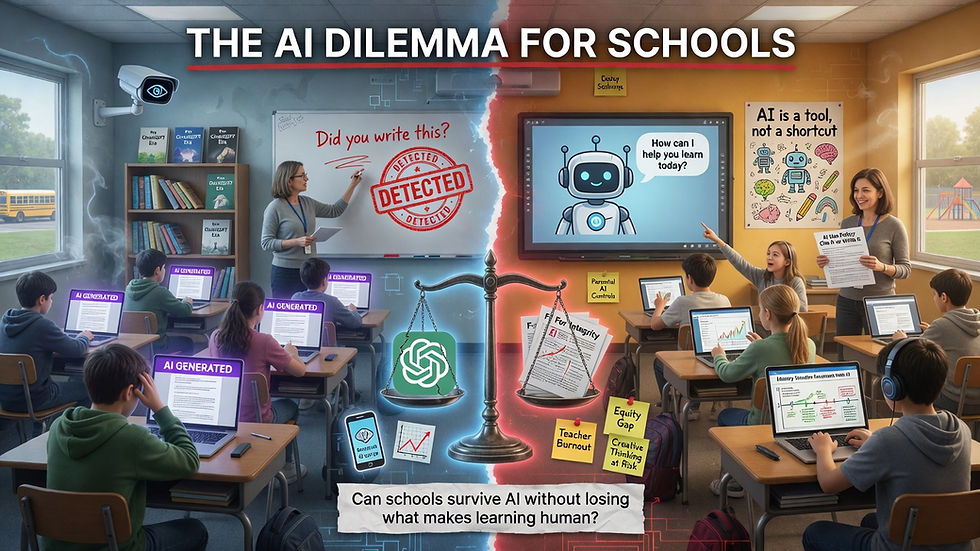
One of the biggest hurdles we hear about from school boards is the fear that AI is meant to replace teachers. Let’s be very clear: AI is a tool, not a replacement for the human connection that defines great teaching.
A well-crafted policy should explicitly reject "The Replacement Mentality." Instead, it should frame AI as an "efficiency engine." If AI can handle the grading of a multiple-choice quiz or help draft a permission slip, that gives the teacher five more minutes to sit one-on-one with a struggling student.
At Haddock, we’ve spent decades helping schools implement technology that empowers educators. Whether it’s ensuring a teacher has a replacement remote so they don’t have to stay tethered to the front of the room, or helping a board draft an AI framework, our goal is always the same: keep the focus on the student-teacher relationship.

Academic Integrity: Defining the "New Cheating"
Remember when Wikipedia was the enemy? Then it was Google. Now, it’s ChatGPT and its successors. If your district doesn't have a policy, "cheating" becomes a moving target.
Your policy needs to define the spectrum of AI use:
Prohibited Use: Direct copying of AI-generated text.
Assisted Use: Using AI to brainstorm an outline or check for grammatical errors.
Integrated Use: Learning how to "prompt" an AI to solve complex problems: a skill that will be vital for the 2030s workforce.
By setting these standards now, you protect your teachers from having to make "judgment calls" on every single assignment. It creates a fair playing field for all students.
How to Pay for It: Funding Your AI Strategy
Let’s talk about the elephant in the room: the budget. With the "ESSER Cliff" now in the rearview mirror, many districts are looking for sustainable ways to fund new technology initiatives. AI implementation requires more than just a software subscription; it requires robust infrastructure, teacher training, and modern classroom displays.
Here are a few funding avenues we’re seeing districts successfully use right now:
1. Title IV-A Grants
These funds are designed for "Student Support and Academic Enrichment." A large portion of this can be used for the effective use of technology. AI literacy falls squarely under this umbrella.
2. State-Specific STEM and Tech Grants
Many states in the Midwest have introduced specific grants to bolster "Future-Ready" skills. These are often competitive, but having a clear AI policy already in place makes your district a much stronger candidate. It shows you have a plan, not just a wish list.
3. Modernizing E-Rate Usage
While E-Rate traditionally covers "pipes and wires," the focus on internal connections and the infrastructure needed to support high-bandwidth AI tools is a vital part of the conversation.
4. Local Bond Measures
We’ve helped many districts communicate the value of technology to their local communities. When parents understand that a bond will provide the interactive panels and the AI-safe environment their kids need to stay competitive, they are much more likely to support it.

The Haddock Advantage: 45 Years of Midwestern Trust
Why partner with Haddock for this? Because we aren't just a vendor from a call center who doesn't understand the unique challenges of a school district in the midwewt. We live here. We’ve been here since the days of Oregon Trail.
We understand that for a school board, "trustworthy" isn't just a buzzword: it's a requirement. When you implement an AI policy, you need a partner who can ensure your classroom technology is ready to handle it. From insuring your equipment is ready for interactive AI lessons to providing the professional development your staff needs, we handle the technical heavy lifting so you can focus on policy and leadership.

Taking the First Step: A Checklist for Boards
If you’re ready to start the conversation, don't feel like you have to write a 50-page document overnight. Start with these three steps:
Form an AI Task Force: Include a mix of administrators, teachers, parents, and even a few students. Be sure at least a few are a bit tech-savvy.
Audit Your Current Usage: Ask your IT department what AI tools are already being accessed on the district network. You might be surprised.
Prioritize Privacy: Before you decide how AI is used for learning, decide how it will be blocked for data mining.
Conclusion
The conversation around AI in schools isn't going away. It’s evolving every day. By establishing a clear policy now, your district isn't just reacting to a trend: you’re leading your community into the future.
Whether you need a full tech audit or just help planning for the future, Haddock Education Technologies is here to help. We’ve been your neighbor for 45 years, and we’re excited to see what the next 45 years of classroom innovation will bring.

Let’s get your district AI-ready. Contact us today to learn more about how we can support your technology goals and help you build a safer, smarter classroom.
Richard Haddock
Comments