

The AI Dilemma:
A Roadmap for Schools, Classrooms, and Administrators
For decades, the "next big thing" in education technology followed a predictable pattern: a new tool would arrive, early adopters would experiment, and eventually, it would either become a staple (like the interactive whiteboard) or a relic of a specific era.
Artificial Intelligence is different. It isn’t just a tool; it’s a shift in the very foundation of how we process information. In the Midwest districts we serve at Haddock Education Technologies, we’re seeing a palpable "AI Dilemma." On one hand, there is the pressure to innovate and prepare students for a workforce where AI literacy is non-negotiable. On the other, there are valid concerns about academic integrity, data privacy, and the potential loss of human connection in teaching.
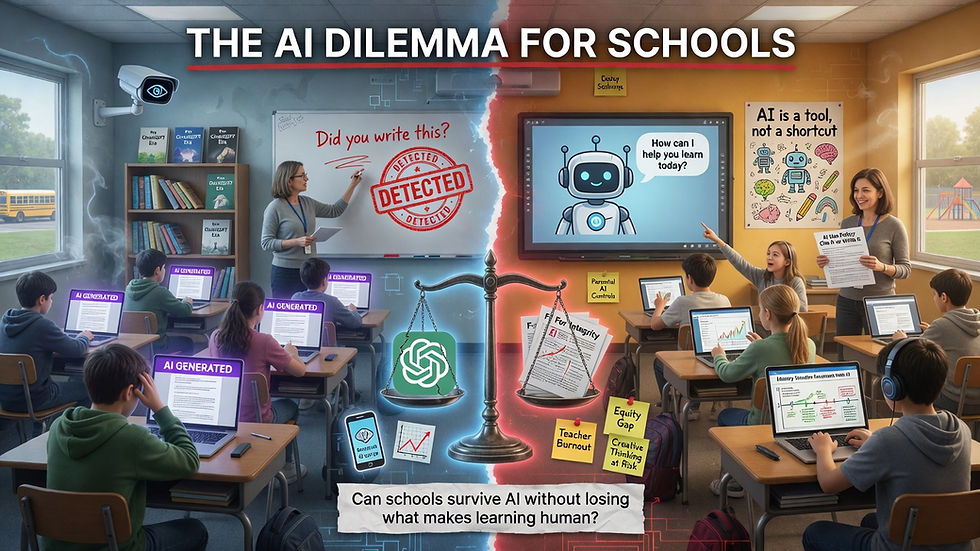
As of May 2026, the data is clear: over 85% of educational organizations have integrated AI in some capacity. However, the gap remains in how it’s being used. Rushing in without a strategy leads to "tech bloat," while ignoring it leaves your students behind.
This roadmap is designed to help Midwest administrators and educators navigate this dilemma with a focus on trust, efficiency, and student-centered outcomes.
Phase 1:
The Administrative Roadmap – Moving from Policy to Empowerment
Administrators are the gatekeepers of school culture and safety. For leadership, the AI dilemma isn’t just about "to use or not to use"; it’s about creating a framework where staff feel safe to innovate.
1. Establish Governance (The "Guardrails")
Before a single student opens a chatbot, your district needs clear governance. This means updating Acceptable Use Policies (AUP) to specifically address generative AI. It also means ensuring compliance with the latest regulations, such as the 2025 TAKE IT DOWN Act and established standards like FERPA and COPPA.
Governance shouldn't just be about what people can't do. It should define what responsible use looks like. For example, creating an "AI Transparency" policy where students and staff disclose when and how AI was used in a project.
2. Operational Efficiency: Reclaiming Time
The biggest win for administrators is the gift of time. AI can handle the "heavy lifting" of data analysis and repetitive communication:
Predictive Analytics: Use AI to identify students at risk of falling behind or dropping out. Research shows AI-powered early warning systems can reduce dropout rates by up to 15%.
Communication Automation: Administrators spend hours drafting newsletters, emails, and reports. AI tools can take raw notes from a school board meeting and turn them into a polished community update in seconds.
Schedule Optimization: AI can solve complex master scheduling puzzles that traditionally take weeks of manual effort, ensuring better resource allocation across the campus.
Phase 2:
The Classroom Roadmap – AI as a Teaching Partner
The goal of AI in the classroom isn't to replace the teacher; it’s to amplify them. As we’ve seen with our Interactive Flat Panel installations across the region, the best tech serves as a hub for human interaction, not a replacement for it.
1. Personalized Learning at Scale
Teachers have always dreamed of creating individual lesson plans for every student, but the math never worked: until now. AI can take a single lesson on the American Civil War and instantly differentiate the reading level for five different groups, or translate the core concepts for an ESL student.
2. The "First Draft" Helper
AI is excellent at overcoming the "blank page" syndrome. Teachers can use it to:
Generate rubrics for complex projects.
Create quiz questions based on a specific YouTube video or article.
Draft 5-day lesson plans that align with specific state standards.
Using the voice chat feature you can even brainstorm ideas.
3. Interactive Integration
To truly bridge the gap between AI and the physical classroom, schools are integrating AI-driven insights directly onto their interactive displays. Whether you are using Promethean, SMART, Newline or Viewsonic, these panels allow teachers to pull up AI-generated visualizations or interactive simulations in real-time, making abstract concepts tangible.
Phase 3:
The Student Roadmap – Teaching the "Human" Element
If a machine can write an essay, what is the point of the essay? This is the heart of the AI dilemma for students. The roadmap for students must shift from production (what they can make) to evaluation (what they can judge).
1. Critical Thinking and Prompt Engineering
Students need to learn that AI is often confidently wrong. "Hallucinations" (where AI makes up facts) are a feature, not a bug. Classrooms should move toward "Socratic AI" methods, where students prompt an AI to argue a point, and the student's job is to fact-check the AI’s response using primary sources.
2. Immersive Experiences
For schools looking to go beyond the screen, tools like ClassVR and programs from WozED allow students to step into environments that AI helps create. This moves learning from a passive experience to an active, sensory one, where AI handles the environment and the student handles the exploration.
Phase 4: Addressing the Funding Gap (Post-ESSER Reality)
We understand the concern that has been looming over the Midwest: the "ESSER Cliff." The massive influx of federal pandemic relief funds has dried up, yet the need for advanced technology is higher than ever.
How do we fund an AI-ready roadmap in 2026?
Title I and Title II Funds: Many districts are successfully repurposing Title II funds for AI-specific professional development. Since teacher training is the #1 barrier to AI success, this is a strategic move.
E-Rate Expansion: Stay tuned to FCC updates regarding E-Rate expansions that cover more internal connections and cybersecurity measures, which are foundational for AI.
State-Specific Grants: Many Midwest states are launching "Innovation Grants" specifically aimed at workforce readiness and AI literacy in K-12.
Creative Bundling: At Haddock, we work with districts to maximize their budgets through trade-in programs and bundled hardware/software solutions.
Maintaining the "Human-in-the-Loop"
The roadmap to successful AI integration is paved with better training. Currently, while many teachers feel comfortable using AI for their own planning, far fewer feel equipped to teach students how to use it responsibly.
The "Haddock Way" is about ensuring that technology never obscures the relationship between a teacher and a student.
AI should be used to remove the administrative "clutter" of teaching: the grading of multiple-choice tests, the drafting of permission slips, the sorting of data: so that teachers can spend more time on the things AI cannot do: providing emotional support, mentoring, and sparking genuine curiosity.
Next Steps for Your District
If you’re feeling the weight of the AI dilemma, you don’t have to solve it alone. Start small:
Pilot a Program: Pick one department (like Social Studies or Math) and provide them with a 90-day AI sandbox.
Audit Your Hardware: Ensure your classroom displays are updated to support the latest software integrations.
Survey Your Staff: Find out who your "hidden experts" are. Who's using AI, and what are they using it for. Chances are, you already have teachers using AI effectively: let them lead the way.
The dilemma of AI isn't a problem to be "solved" so much as a new landscape to be mapped. With the right roadmap and a focus on trustworthy technology, your school can move from uncertainty to mastery.
Need help navigating your school's tech refresh or exploring AI-ready hardware? Haddock Education Technologies is here to help schools bridge the gap between today’s challenges and tomorrow’s classroom.
Contact us todayto learn more.
Comments